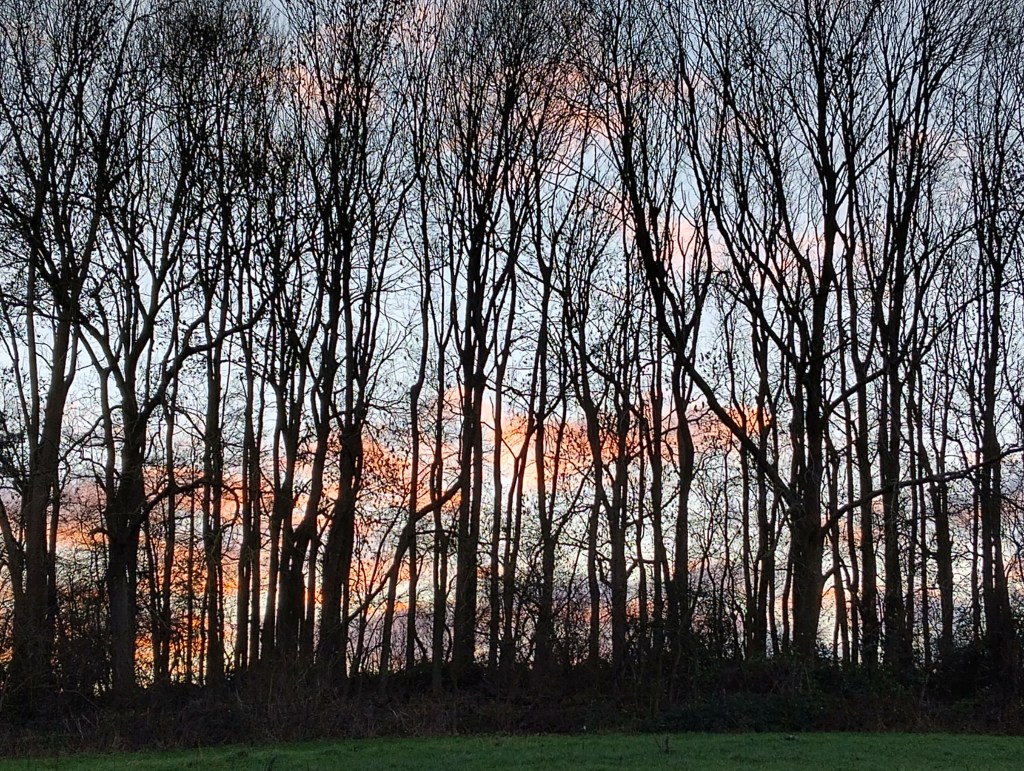
Sunset, 24 December 2025, Leicestershire
For many – in the lands where Christmas is celebrated – this festival can become sullied, banal, or a ritual of family endurance to be suffered annually. And then there is the consumerism and excess that often take the place of real sentiment. (That said, of course, for many people Christmas is truly a joyful time and is spent with those they love and none of the above cynicism has application.)
And yet Christmas rests on an image: the image of the baby in the manger, the virgin mother, the angels and the wise men and the dreaded Herod. The baby, tiny, frail, represents the light of the world, our reality and our own light. His mother, the archetype of pure feminine, perfect receptivity and obedience. The angels and wise men, visitors from other planes of the divine order, obscure to us yet magical in effect. King Herod, the jealous ruler, modelling human reactions all too typical. For all the tawdry externals, this image lies deep in us, inspiring nostalgia, precious, delicate yet enduring. From the time we hear the story, usually as children, it resides in our imagination, deepening and settling there and informing our experience of Christmas in our own lives.
Other objects in our everyday lives act as symbols that point back to this imaginal realm. Gathering holly and berries for a Christmas wreath, we are struck by the autumnal reds and browns, the deep green, the shapes of leaves and branches. Surely these also indicate something more ancient in us, certainly older than our own lifetimes, perhaps established in our culture, perhaps even deeper and older than that? And by extension, it is not just berries and leaves that are symbols. Perhaps everything in this world is a symbol – every object of nature, perhaps man-made objects as well, and not just objects but relationships – verbs – adjectives – we thus move as symbols among symbols, their ‘meanings’ mostly hidden from us, yet in constant relation to us.
So what is this imagination? Where is it and how does it work? Or, to ask differently, whose is it? Where does it begin and end? Do we all participate in a single imagination, or do we each have a separate one? For me there is an urgency in asking these questions. Here are some ideas, drawn loosely from Ibn ‘Arabi and explained by Henry Corbin in his classic ‘Creative imagination in the Sufism of Ibn ‘Arabi’ first published in 1969. Imagination, in our age, is seen as something trivial, or optional – and is reduced to trite notions of ‘creativity’ or fantasy. But it is surely – surely – much, much more than this. What is the universe in which Bach wrote his inventions and suites? They are not so much melodies as measures of sheer intelligence, coded as music and infinitely transmissible. In this world they reside on paper and in recordings. In that world, they have no container. And ditto for all of the arts, academic and popular alike.
Maybe what we are talking about is the collective unconscious described by Carl Jung. Certainly, this models a lot of our experience, and posits a shared space, beyond our personal unconscious, in which universal archetypes and patterns reside and in relation to which we individually respond in life. Psychologically it makes sense.
The Sufis (and maybe others), however, go much further. For them, the imaginal realm is an objectively existing reality, a plane or universe, that is ‘situated’ between heaven and earth – or between spirit and embodied physical existence – or between sheer being and its manifest expressions. This is the place ‘where spirit takes on form’ and ‘form takes on spirit’. So the reality of Christmas, emerging from spirit, takes on a form, or image, here, that in turn informs us in life – while the stories we tell of Christmas ourselves, curated in imagination, gain the wings of spirit.
For Ibn ‘Arabi and others, all three of these levels (plus others that occur in between) are present in every instant. We who inhabit physical bodies and a physical world, also receive experience from the spirit world (which sustains life) and also from the imaginal realm. When we dream, during sleep, we may experience that imaginal realm directly and undiluted. All these levels are present, to themselves and to us, in (or as) the moment. And what appears in this world, such as ourselves, has an image in the other realms that are appropriate to that realm. Each of us has an image in the imaginal realm – an archetype of ourselves, which represents our potential as creatures, and we may succeed or fail in finding out what that image is like.
Returning to Christmas, again, we can place the image of the birth of Christ somewhere in the imaginal. Perhaps there is a still more quintessential image than this, the primordial light, the divine spirit of God ‘breathed’ into Mary, the mixing of actual and virtual waters, that rests in the collective imaginal. All this is projected into our world, be it into an orderly, religiously arranged world in which Christmas is celebrated accordingly, or into a post-religious, secular situation in which the imagery is deconstructed and the festival is also secularised. Be this as it may, it arrives from that imaginal point, and from sheer Spirit before it.
We dwell in all of it together, all of it, together. The Divine Spirit that blows acts here and now, but since it is spirit, we can’t apprehend it directly. The image of the conception and birth of Jesus, with or without the props of the Christmas story, inform us from the Imagination. And we find ourselves here, making sense of it as we can, and left to respond to these primordial arrivals in our hearts. Perhaps Christmas is in fact the celebration of this in itself – we celebrate our realisation that we come from spirit, are maintained by spirit, that our reality is vast and far from the limited notions we normally have of ourselves. Surely this is tidings of comfort and joy. Not in a megalomanic sense but one of inspiration and vision, which of themselves beget humility.
 Be_flummoxed