The four concerts have come to pass and the choir has fallen silent and dispersed. We sang what amounted to the Requiem Mass, made up of individual movements of that liturgy by different composers, arranged by period. The programme thus opened with a Gregorian chant, moved quickly through representations from the Renaissance, Baroque, Classical and Romantic periods and arrived at a beautifully compiled conclusion of 20th and 21st-century compositions, ending with Maurice Duruflé’s magically ethereal In Paradisum.
As we started rehearsing this programme late last year, I was not impressed with the idea. Certainly the individual pieces were beautiful and moving, and I was stirred by both their musical beauty and the devotional intention invested, to a greater or lesser extent, in each of them. Most of all by the raw Gregorian chant of the men’s voices, innocent of any sense of performance and without a conductor, evoking cloistered monks down the centuries:
Requiem aeternam dona eis Domine, et lux perpetua luceat eis.
Rest eternal grant them, O Lord, and let light perpetual shine upon them.
I wrote about this earlier in the year, see here. Yet I could not help feeling that there was something contrived about a pick-and-mix of different composers and styles for reasons that (I assumed) were no more than aesthetic. Erroneously perhaps, I like to think that the meaning of the requiem is too important for such aesthetic considerations to enter. Yet what did I know about the motivation for our director and her colleagues who designed the programme? It turns out that it was conceived in memory of a much loved fellow musician who died the previous year.
Having a dual sequence – the progression of the liturgical text and the historical movement through compositional periods – lent a sense of not just a beginning and an end but of birth and death to the programme. Though this, for me, was secondary to the reality of being and dying, to which the requiem alludes and which are not bound by time. Rather that time emerges from that reality and in accordance with its configuration. And so the different musical styles are different expressions of the same underlying meaning, giving a framework to time but pointing back to a perpetual origin. Nonetheless, for us, creating a temporal scaffold on which to present these expressions, there could not but be the movement from birth to death, just as music itself is time-based, even if its effects are not.
And so, if the requiem itself is a journey, with death as its beginning, where does it end? Lux perpetua, perhaps, light perpetual – the complete rest and acceptance that death affords. For us here, meanwhile, there were plenty of small journeys to complete too. The process of our learning the parts, the half dozen rehearsal weekends in which we intensively learned the pieces. The gradual learning, the eventual enchaînement, the ingenious use of tuned percussion (in particular a vibraphone, improbable in church music but played superbly well and in the end with a ringing, heavenly quality) and the final birthing of the concerts. Other ‘lifetimes’ were involved also, notably those of the planning, the preparations, the running of the choir, all of which cost many hours of volunteered effort.
For me, and doubtless for all of us, each piece grew familiar and took on a character, like a person. Each was linked in my mind with particular memories of the rehearsals: the hall in Alairac, the lanes around the village, some with sweeping views, where I took walks and gasped for air during the breaks; the elaborate car-sharing involved in getting to rehearsals. And more than that, I remembered each for the effect of music and text, luminous, uplifting, comforting, or rigorous, disquieting, and the sense of astonishment at being able to participate. But as the concerts drew close, the programme acquired a singular nature of its own: no more a hodge-podge of greatest hits but a living thing in its own right, born of the care and effort put into creating it and perhaps of the spiritual intentions of the music of itself.
My other contention with the project was the sense that the music has grown too virtuosic, too symphonic. Rather let’s go back to the chant, strip it down, take out all pretence, so that we can sing from the heart while focusing on the devotional purpose. There was never an intention to ‘perform’ the Requiem or make it into a concert. For the audience too, I feared that our production would not reach beyond the merely aesthetic. But again, what did I know? Was it not good to leave it open-ended, let the music (and whatever quality we brought by our presence) speak for itself? In the end, aesthetics is beauty, and Beauty speaks for us all. This takes us full circle, and stirs each heart individually as it will. So maybe rather than sticking to a narrow conception of a Roman Catholic mass for the dead, the result is liberated to touch the heart of each as it will, uniquely and also in a sense universally.
Now it is over. Last night and this morning my mind was on a high from the sense of culmination, the sense of a shared endeavour brought to completion and of having offered this wondrous musical body to the public – though also sorrow that it is now over. This euphoria will pass quickly but merits mention. I will miss the company of the men either side of me of whom I have grown fond, despite only very limited exchanges with them. I will miss the anticipation of the rehearsals and the intensity of working during them. I miss the learning of new pieces and being affected by them. More still, the sense of working towards something, involvement in something, bringing something into being, participating in the birth of something bigger than oneself. The cycle has been completed; the ‘summer’ has passed all too quickly, now the leaves fall until the ‘spring’ returns (paradoxically in the autumn).
In one of the churches in which we sang, the east wall behind us was painted with an immense, icon-like mural of Christ presiding at an altar, surrounded by angels, and high above, the Virgin, spirit-like, carrying the child Christ. Thus, as is held in some Byzantine churches, the Christ is the ‘Land of the Living’, and he dwells in the womb of his mother, named the ‘Dwelling-place of the Uncontainable’. Symbolically a virgin, the Divine Feminine and receptive principle, her meaning is not limited to women but is universal. She is perhaps the human nature in potential that carries the Christ, which is at once the reality of what we are and the potential of what we can become. Or the Jungian image of the child, universally present in the adult, there as his muse and verifier of his truth.
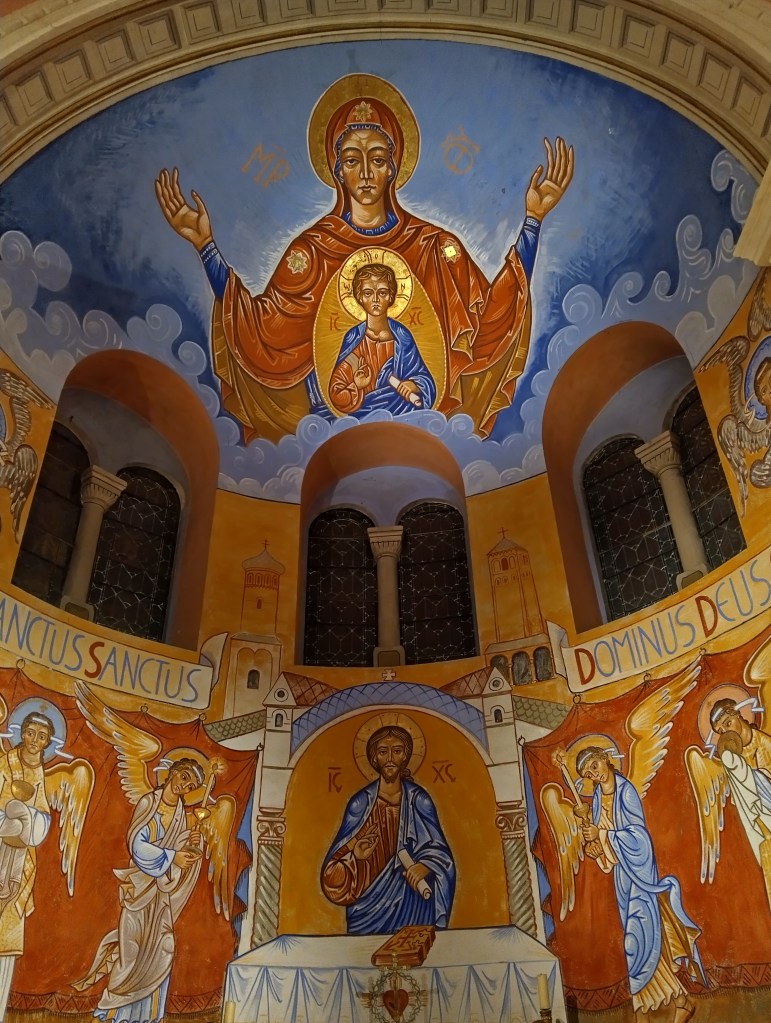
The mural behind the altar, Eglise de l’Assomption, Limoux, France. Painted by icon painter Nicolai Greschny, 1946
So it was in front of this tableau of life in all its completeness, which includes death, that we invoked compassion on the dead, commending the Child of the departed to light perpetual, its own home. And now it is done: a journey has ended, particular to each, shared by all, an intercession, intentional or not, for the souls of the departed, known to us or not. I wonder, can we return to the spirit of the old chant, Requiem aeternam, rough and ready, in a circle, in a monastery church, perhaps in the dead of night or the heat of the day and over the body of one recently departed? The ancestor of all the composed settings. Rising from the close knit of the brothers or the sisters, who chant these chants every day for the rest of their lives, who are family to one another, whose voices are untrained but perhaps smoothed by a life of chanting, their sole purpose the remembrance of that Spirit by which we live and have consciousness and into which we die. So that even trained voices and polished, elaborate extrapolations and convolutions of beauty that flare out of brilliant compositions do not nudge us from that same deep point in ourselves, simple, direct, habituated. The brothers of the old monasteries knew no other way; they eschewed any other way. We by contrast have many ways, and this is just one of them; yet perhaps we can see, in a new, wider meaning, its import and choose afresh to align ourselves more or less to it.
 Be_flummoxed