Preserving the memory of a path is not enshrined in any regulation. Old maps and cadastral plans may conserve a trace, but their erasure from the landscape is inevitable. The only ones that endure are those that are made into a modern road. But who would recognise them, hidden under the asphalt?
Bernard Caubit, Chemins romains et médiévaux en Pays d’Aude, Limoux, France, 2025, from the introduction
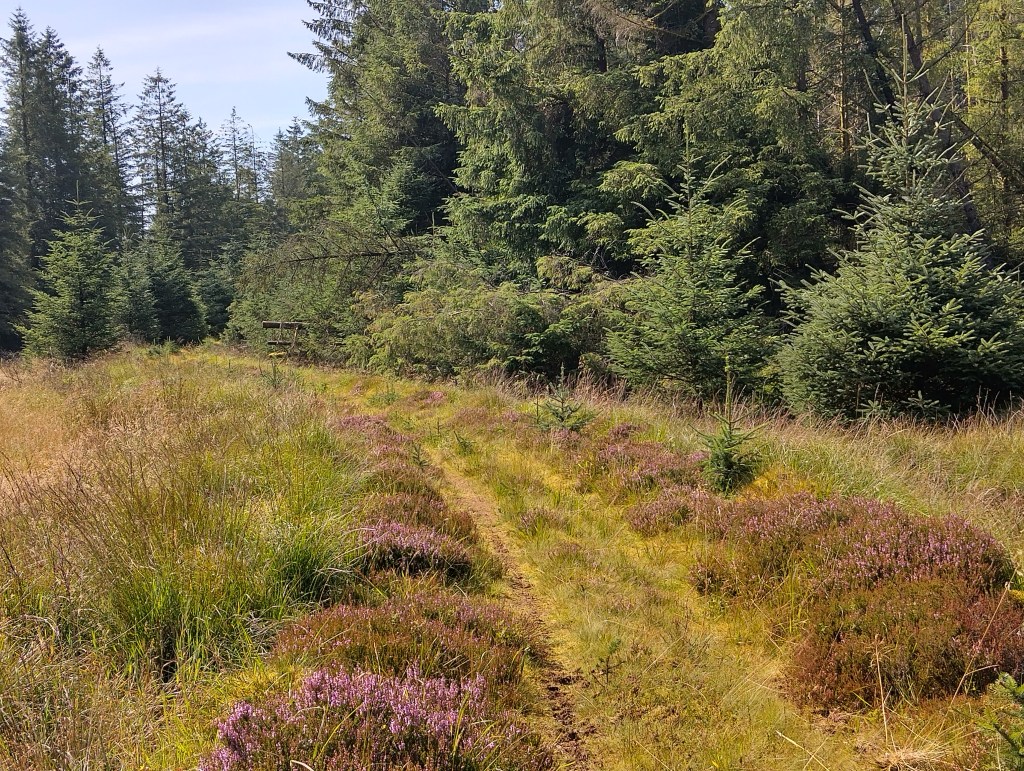
Part of the green track near to Craik Cross that approximates the Roman road
Modern traffic and road-building has resulted in the disappearance of myriad old roads, tracks and paths from all our countries. Perhaps in many cases this can be accepted as the price of so-called progress. Some of the old roads, however, remain significant, even if they are no longer used as such. Some seem to contain meaning through their routing, or the places they connect, that is not passed down to the new roads. An example is the old road that runs south-west from Hawick in the Scottish Borders, following the Borthwick Valley as far as Craik, where it seems to end. While staying at Chisholme, situated along that road, I became intrigued by it. My map showed it as continuing into the vast Sitka spruce plantation of Craik Forest as a forest track, appearing and disappearing here and there, and marked moreover as a Roman road. Running straight as Roman roads do, it ascended to a ridge and then dropped into the valley of the Esk river at Eskdalemuir, right by a place of some significance: the Tibetan Buddhist monastery of Samye Ling, established by lamas who perilously escaped Tibet following the Chinese invasion in the late 1950s. While it is perfectly possible to drive from Chisholme to Samye Ling by modern roads, these are circuitous and winding. I was fascinated by the directness of the Roman road and how accurately it joined our school at Chisholme with the Tibetan centre. Would it be possible to trace the route, by bicycle maybe, or on foot? Surely others must have done so before; but nobody was able to tell me.
My first attempt was in 1997. I cycled south-west along the Borthwick valley from Chisholme to where the road ended at Craik village, then followed one of the forestry tracks that seemed to parallel the Roman road. Its rough stony surface climbed steadily for a mile or so before turning away. In its place, broaching the shoulder of the hill, ran a track entirely in green, evidently little used: grass and moss on the verges, in the central ridge and in the wheel tracks. Up here the forest was thinner, the ground boggy. To left was a wide gap in the trees that ran parallel to the track, a ride of some fifty metres’ width. Perhaps this was just a fire break for the trees. Or perhaps the original Roman road lay under the gap. Something about it seemed to speak. Bushes and stunted spruce trees grew on the sides of the track and the wheel tracks were soft under my wheels. I felt anxious lest this was the wrong road, heading ever deeper into this remote, if artificial, forest. Yet there was something here that drew me on. I felt certain that this mossy, little-used track was indeed the way indicated on the map, and the open ride beside it seemed somehow confirmation. The green was mossy, emerald, and the track, lined and soft, felt somehow regal, a royal road. As I followed it further, the attraction to continuing grew stronger.
Nearing the ridge on the map, the track narrowed to a single path, blocked by a number of storm-blown trees. I decided to leave the bike and continue on foot. I hid the bike in the dark stands of spruce, trusting I’d find it again on the way back, and walked on to the top. A circular clearing in the trees, the open ride bisecting it and continuing on down the far side of the hill. In the centre of the clearing was a faintly discernible mound. This must be Craik Cross, thought to have been a Roman signal station. Smoke (in daytime) or fire (at night) could be signalled from here and picked up on the Eildon Hills, visible in the far distance behind me, or on the formidable peak that lay south-west, somewhere in Dumfriesshire. Thanks to the ride, these lines of sight were clear, while all other directions were masked by a curtain of trees.
The path did not continue beyond the summit. Beyond was a different forest administration with a separate set of tracks. I would have to make my way through stands of trees in the hope of finding one. Trusting that having been brought this far, it should be permitted to continue, I set off in what I judged to be the right direction through a dark group of spruce. Thankfully it was not long before I found an old track, which then came out on a newer, well-maintained one. Steering south-west and downhill, an hour or two later the track brought me to the far side of the forest, the Esk Dale. Minutes later I joined the road there and reached the monastery. Turning into its grounds, with its stupas and flags, felt immensely welcoming after the silence and sterility of the plantation.
I remember little of my first visit. The tea room will surely have been open, and the shop – and I recall rather timidly entering the temple, to be bewildered by the richness of coverings, colours, symbols, musical instruments, and the hundreds of Buddha figures that seemed to have their eyes on me. How much more astonishing could this be for a traveller in the highlands of Tibet, arriving out of an empty and freezing landscape into such opulence? Too self-conscious to attempt to meditate, I stared for a few minutes and left. Aware of the limited daylight, I was soon on my way back into the forest for the return journey. A track led for two hours in roughly a north-easterly direction. When it turned away, I struck uphill through trees – and, happily, emerged near to the Cross. Retrieving my bike and the mossy track, an hour later I was back at Chisholme, too late to tell anybody of the adventure over supper. But I felt that something had been given to me in making the crossing, this hidden link between the two neighbours.
*
We have made this ‘crossing’ several times since then. At one point a footpath was established that ran from the Cross and linked the two sets of tracks, with signposts all the way from Craik to Eskdalemuir. Suddenly it was easy to find one’s way, I could cross the forest in two hours or so, or ride from Chisholme to Samye Ling in under three. In 2015 a group of us walked from Craik, taking some four hours to reach the monastery. Subsequently, funding for maintaining the path was cut and it was no longer maintained. I could still make it out and follow it, crunching spruce seedlings under my wheels and fearing for my bicycle tyres, but I suspected that soon the situation would revert to how it had been in 1997.
*
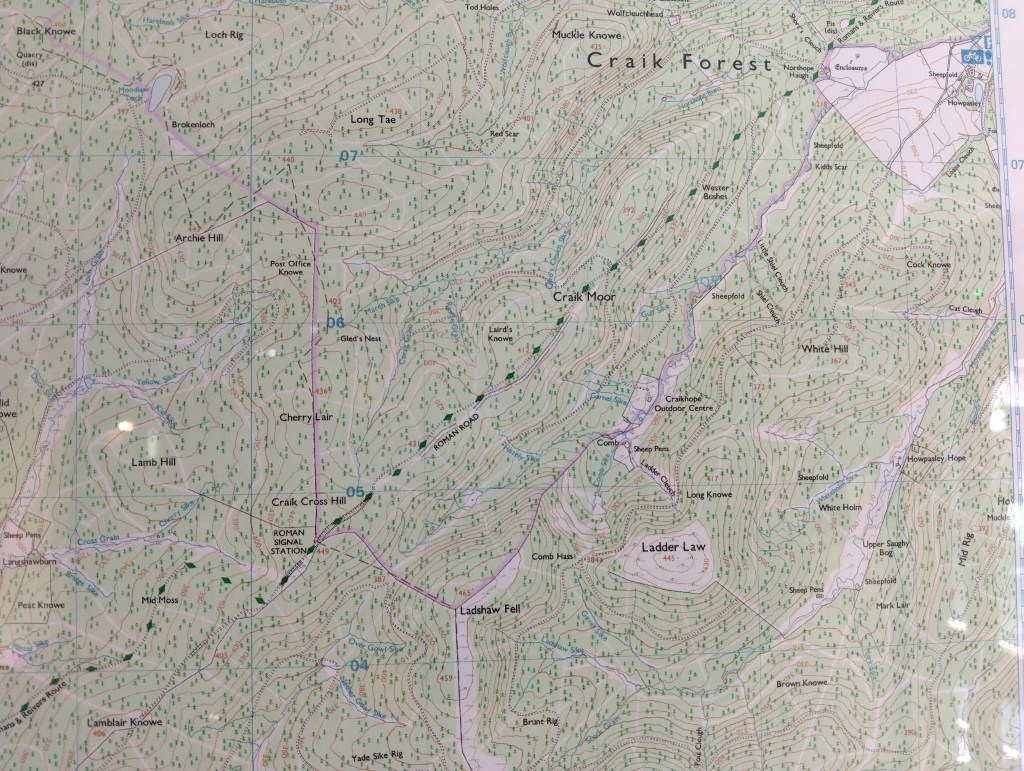
Part of the Roman road showing Craik Cross. Map copyright Ordnance Survey
In August 2026 I made the crossing again. I wanted to see whether the path was still usable, or still there at all, and I desired to visit Samye Ling. On a day that seemed auspicious for weather I set out from my home in Hawick, half expecting to find the path impassable and to have to give up, or to abandon the Roman road for the modern one. For some reason I felt anxious. The link felt tenuous, the crossing suddenly precarious. As I entered the forest, several things seemed sent to deter me. The road to Craik was closed in two places for resurfacing, though I could make my way past. As I started climbing the forest track, a loaded timber truck came at me at speed, forcing me into a ditch to get out of its path. Signs were laid out along the track warning me to turn back because of forestry activities. But no such activities could be heard and I passed without incident; the signs had probably been left there for days or weeks. Every now and again a little purple-coloured waymarker cheered me along. Still bearing the name of the defunct footpath, ‘Romans and Rievers Route’, I felt I had every right to be there and drew courage. And now I was under way, the old sense of attraction was strong again.
Thirty years since crossing for the first time, much of the landscape had changed in the Craik plantation. Swathes of spruce had reached maturity and been clear-felled, leaving open-wounded spaces of stumps, the ground seeming to still be growing accustomed again to daylight. The first section of track had been upgraded almost to a road, to allow mass extraction of timber on big trucks. About half of the soft green track, my royal road, had been subsumed under this modern track as the extraction spread higher. As I made my way towards a Buddhist centre, the principle of impermanence – so central in Buddhist teaching – was uppermost in my mind. Everything is subject to change; nothing stays the same. And so we must be ready to let go, including ultimately of our own lives. And this forest, an artifice to begin with, built for short-term growth and harvest cycles, was a case in point. Half a mile before Craik Cross, a mobile signal booster station had been set up, its antennas visible for miles. Still, the irony of this modern signal station being situated so close to the old Roman one was not lost on me; some things do not change.
Soon after the mobile phone station, meanwhile, the new track ended abruptly and out from under it there emerged the remainder of the old green track. I was delighted to feel its silky smoothness again, and that it was surprisingly clear of growth. Someone had perhaps been along with a cutting machine to keep it open. Still the vibrant green, even in this dry summer. The open gap was still there alongside, and now the recent scars in the forest were well behind. My spirits lifted: there is still something about this road, something that remains, that is alluring. Not to mention the promise of the fabulous, scarcely conceivable confection of the Tibetan monastery waiting at its end, standing out from the artificial monotony of this forest.
I had my lunch at the Cross, recalling doing so back in 1997 on a day not unlike this one. A signpost, erected as part of the footpath, indicated Hawick one way and Ae the other. I could sense that man had known this spot for a long time. This lonely peak had been the point of signalling for miles around. Despite its now being blanketed in a sterile plantation, its history was something I could feel in the ground itself.
Going down the far side, the path became indistinct for a time and I picked my way through the long grass of the wide ride. Fortunately, memory reminded me where the path should drop away from here, the course of the Roman road, to a modern track; there was no marker post and it would otherwise have been missed. The path down was still clear, and had been maintained – where young spruce trees had started to grow on it, somebody had cut them back with a chainsaw so that their spiky branches did not block passage. So somebody, perhaps a volunteer, probably known only to few, was keeping an eye on this route and keeping it open. Quickly I rejoined a modern track. An hour or so later, give or take some confusion where a waymarker was missing, I emerged onto the Eskdalemuir road and quickly covered the mile or so to Samye Ling.
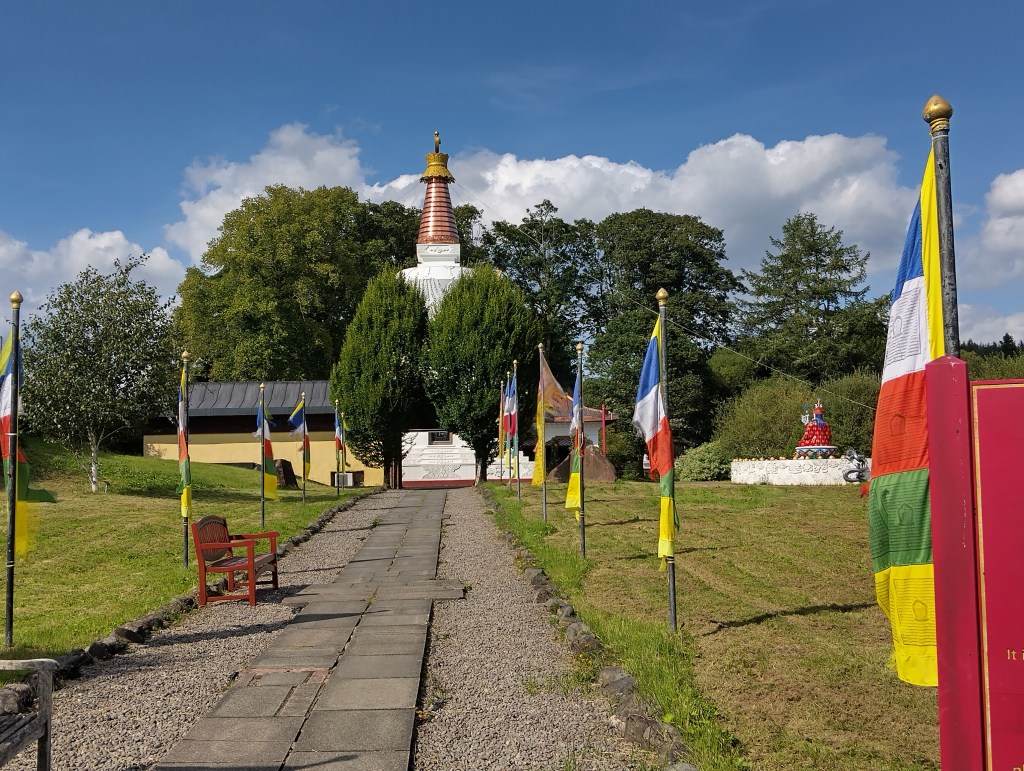
Entry to Samye Ling Monastery, Eskdalemuir and the Peace Stupa
Arrival at the monastery this time felt special. The attraction I had felt along the old road blossomed now in the arrival. Flags in yellow, blue, white, green and red, and the rows of stupas lining the driveway – not only a tonic after the monotony of the forest but their appeal to the person, to the heart of the person. I was unsure what the stupas’ function is or why they look as they do, and they reminded me of something from a high-voltage electrical installation. In any case, though, they must have to do with purification, with spiritual intention, perhaps that of broadcasting compassionate energy to all sentient beings. I have no Buddhist training and no relationship to the place, beyond occasional, casual visits, yet sensed a deep welcome here and a sense of concentrated presence. Again I made a beeline for the tearoom and the shop, as they are prone to close early. The tearoom, with its millionaire shortbread, is a well-frequented stop for cyclists hereabouts. That done, I could do the thing I most wanted: to visit the temple. I asked a woman in robes at the door whether it was possible to go in; she looked surprised that I had asked. Of course you can go in, she said, not flustered by my garish cycling garb, just leave your shoes outside. I sat there for some time, on one of the ordinary chairs at the back provided for visitors, and let myself settle.
The assault on the senses of the interior could surely never become familiar. Slowly, blinking, I took in the colours, the goldwork everywhere, adorning the deep red of the interior, flowers, hangings and Tibetan artworks, a series of gigantic gongs and drums. And most of all, the central, elevated figure of the Buddha, golden, radiant, surrounded by mythical creatures and wondrous haloes. Strangely like an Orthodox Christian icon, or a Far Eastern take on one – a transfigured human figure that relates to us in a fully awakened condition, the similarity heightened by the gold and the haloes. Either side of him, tiers of small buddha figures, hundreds of them. I wished for somebody to explain the different figures and why so many. Sufficient, meanwhile, to sit here and sense the presence in this place. So many realised beings, so many who have realised their inherent Buddha nature, their potential to be completely human; so many ways of arriving there. Gradually it dawned on me that a monk was seated there, on a kind of throne, wrapped in robes and utterly motionless, meditating. All I could see of him was the side of his head. His stillness was such that I did not see him at first. No wonder there was such a strong sense of presence here.
I closed my eyes now and sank into the rich silence. So deep: a rich, teeming silence, joyful. The noisy mind rolled back, the starry substrate of a deeper mind glimpsed. Samye Ling: ‘the place beyond conception’. And for now, the Tibetan culture and symbols so unfamiliar, it was possible to rest in a place ‘beyond conception’, yet aware that everything here is in service to the transformation of the human condition, that which is common to every person everywhere.
All too soon it was time to leave. I exited the temple and strolled the Peace Garden. The whole place invited to practice, and I felt the invitation. Meanwhile the colours, the images, the alphabets of this place… all have meaning, all can be unpacked into a metaphysical description of reality and man’s passage in it. How is it that little flags and curtains that move in the breeze can capture the imagination so vividly?
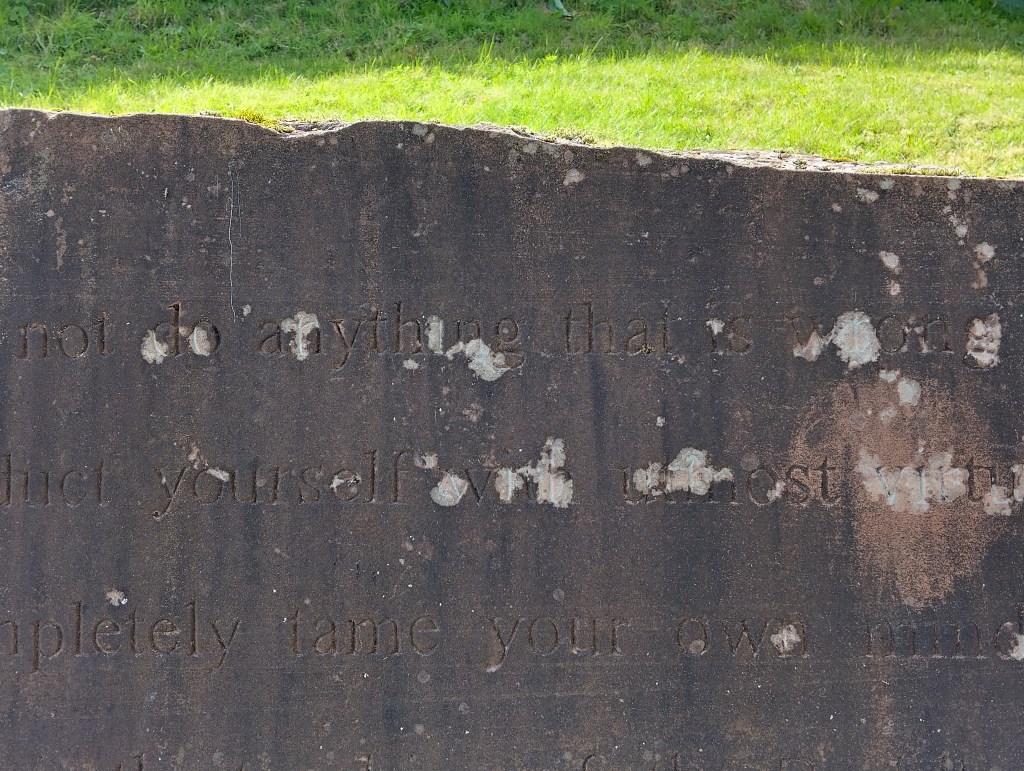
In the Peace Garden is a rock on which are carved the principles of Buddhism:
Do not do anything that is wrong.
Conduct yourself with utmost virtue.
Completely tame your own mind.
This is the teaching of the Buddha.
This summary has a striking resemblance to the ‘four pills’ taught at Chisholme:
… [T]he first [pill] is that you be sure that there is one absolute, because there can’t be two;
The second is that you must keep everything clean;
The third thing is that you mustn’t harm anybody,
and the fourth thing is that you must be helpful to everybody.
Perhaps the taming of the mind and the certainty that there is only one absolute amount to the same practice. As we come to recognise the non-existence of ourselves and our thoughts, our constructions, we grow more and more certain of the singular Being that is our being.
*
As I returned home, this time via the modern, winding, circuitous (but scenic) road, I mused over how it is that our two centres – the Chisholme Institute and Samye Ling – should find themselves so close together, and that they were founded at roughly the same time. I am prone to error here: either I ignore any significance or meaning, and attribute the fact to mere coincidence, something random, or else I impute too much meaning, making great gushing statements about divine purposes and usually pretending to know more than I do, which is nothing. Neither of these is truthful. The proximity of Samye Ling to Chisholme isn’t accidental. Nor is there some graspable logic to it. So surely the truth is, if you like, somewhere in between, but not linked to either of these. Perhaps both, despite their very different traditions and lineages, are the result of a particular era, that of the 1960s and 1970s but continuing today. This could be called an emergence, linked to the spiritual evolution of humanity, and that then becomes the basis of time itself.
So Samye Ling was established by Akong Rinpoche and others close to him, lamas who escaped the Chinese invasion of Tibet and were able to bring their culture and practices to the West, both to conserve that lineage and culture and to offer something of global accessibility in a completely different setting. And not so differently, the Beshara movement including Chisholme arose from a Turkish lineage of Sufis, transplanted to the West and made universal, drawing into itself other traditions and wisdoms and offering a global perspective to anybody willing to hear it. Both schools, both systems, both approaches aiming to offer the willing student an education in their highest potential, giving them the possibility of reaching it for themselves and serving the transformation of the world and the time they live in.
*
What kind of a road, then, is this old Roman track, linking these two centres, yet hidden? Direct, short, crossing a central ridge point that was a signal station. Going between two valleys, two realms, two, yes, centres. Perhaps, once, between two kingdoms, the Celtic lowlands and the old Northumbria. St Cuthbert is said to have passed along it. The rivers and the modern roads run about in circles, following the topography; the old road is direct. Just as, in didactic thought, the two centres diverge because of their traditions, yet hidden in the heart, the link between them is immediate. For all that it is hidden, the road can be traversed. One could choose to walk or ride the road as a practice, keeping it open on the ground and in the mind, with much benefit.
That road is not what it seems, I suspect. Just as both of these schools teach that I am not what I think I am; my reality is not as it first seems; and all things are impermanent. And both centres approach this realisation through a healthy diet of meditation and spiritual practice, along with practical work and study or teachings drawn from their respective traditions and beyond. One of them, broadly speaking, focusing on work on the self, refraining from violence and mindless actions, with an emphasis on taming the mind, leading to the possibility of deep peace, the understanding of suffering and how to be liberated from it. The other, likewise refraining from ignorant action, but focused more on an intuitive vision of reality and our place in it and the possibility of our realising and consciously participating in that vision, with study and practices to support the approach. In both schools the groundwork is similar. Once the founder of Samye Ling, Akong Rinpoche, visited Chisholme and somebody asked him why there is so much suffering in the world. His answer: ‘Why is there ‘I’?’ If we continue to identify with the first person singular, the ‘I’, the ego-self, then we are bound to suffer. So we seek liberation from the domination of this sense of ‘I’.
As for these two methods, preparing the self on the one hand and approaching God (presence, vision, knowledge) on the other, and what links them, I recall an exchange reported by Muhyiddin Ibn ‘Arabi, the twelfth-century mystic, concerning the different emphases given by two of his teachers:
One day, when I went to see this Shaikh [Abu ‘Imran Musa al Martuli], he said to me, ‘Be concerned with your own soul, my son.’ I replied that when I had visited my Shaikh Ahmad [al-Uryani] he had told me to concern myself with God; so I asked him to which one of them I should give heed. He said, ‘My son, I am concerned with my soul, while he is concerned with his Lord. Each of us guides you in accordance with his own spiritual state. May God bless Ibn ‘Abbas and make me to reach his eminence.’
Ibn ‘Arabi, from Ruh al-Quds, translated in Sufis of Andalusia by R.W.J. Austin, pp. 88-89. Beshara Publications 1971/Routledge 2008
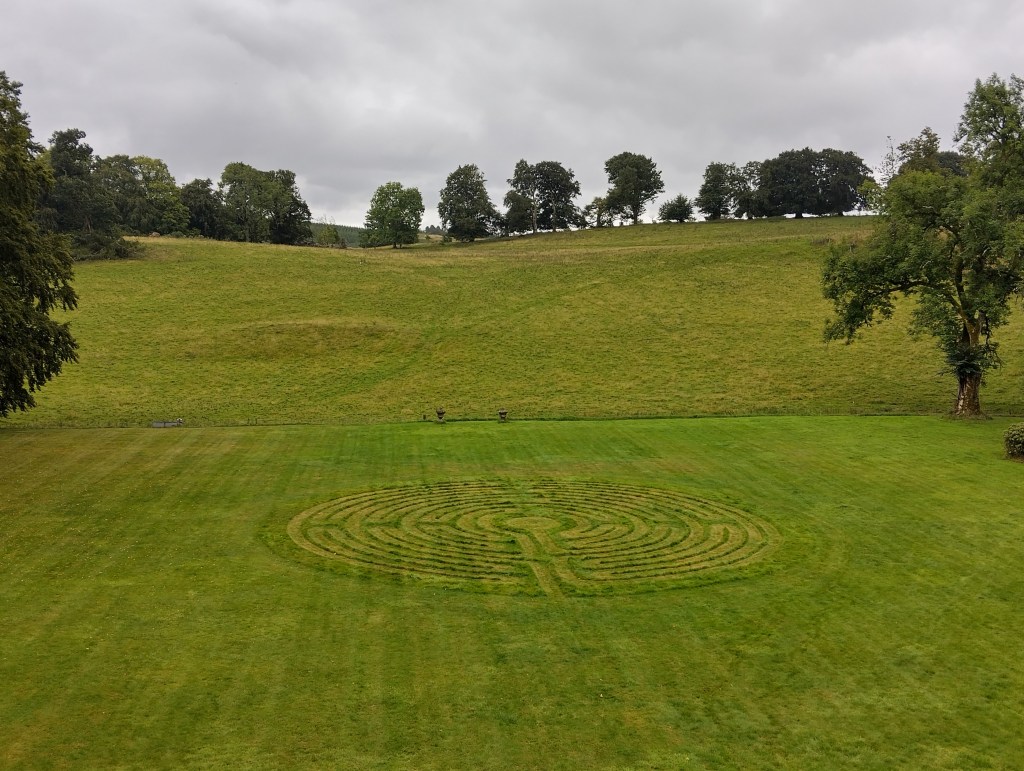
Another hidden road: the labyrinth at Chisholme, summer 2026
In memoriam: Lyndon Antle
We had a friend, whom we at Chisholme knew as Shamsuddin (‘sun of the path’). He had been a student at both Chisholme and Samye Ling, had worked at both places, and put his life to the service of the truth in both expressions. In him, despite physical ailments, was a person of immense freedom. His being made him into a road between the two schools, the road shortened down to a single point. His humility and his certainty could inspire awe.
Lyndon died in the same week that I made the crossing from Chisholme to Samye Ling. That symbolic journey, while slight in itself, is for me a tribute to him and is dedicated to him.

